Module 1: Neuropsychology of Self-Regulation
Establishing the intellectual baseline for the certification — synthesizing competing yet complementary theories of executive dysfunction into a cohesive coaching philosophy.
The Theoretical Foundation
This module establishes the intellectual baseline for the certification. Trainees synthesize competing yet complementary theories of executive dysfunction to form a cohesive coaching philosophy.
Why This Module Matters
Before a coach can intervene, they must understand the mechanism of the deficit. Module 1 answers the fundamental question: Why does my client struggle with things that seem "easy" to others? The answer lies not in willpower or character, but in the neurobiology of the prefrontal cortex and the developmental trajectory of self-regulation.
The Neurobiology of the "Air Traffic Control" System
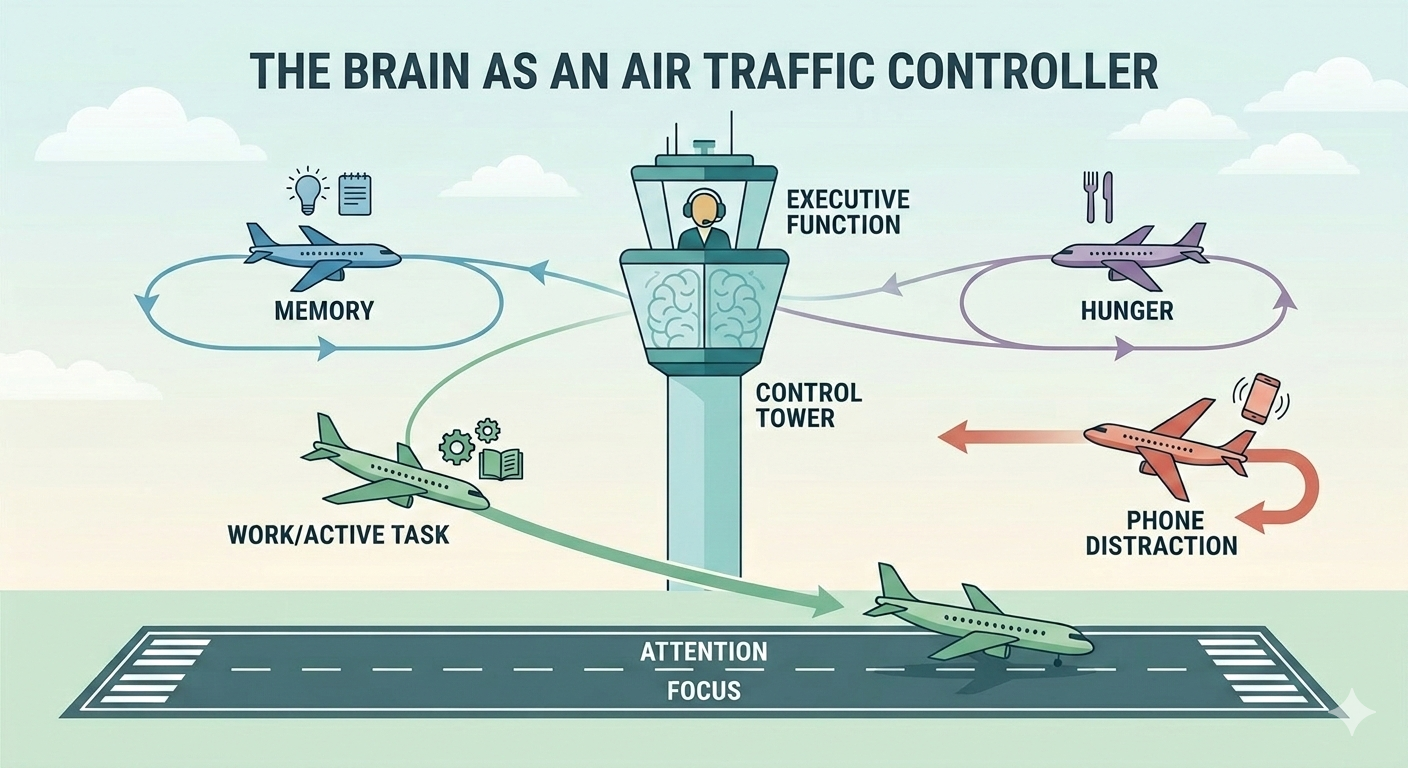
Harvard's Center on the Developing Child provides the foundational metaphor: the brain's executive functions operate like an air traffic control system, managing the flow of information and coordinating complex operations.
The Harvard Metaphor
Just as an airport's air traffic control system manages multiple planes arriving and departing simultaneously, the brain's executive function system manages the flow of information, prioritizes tasks, and enables us to filter distractions, hold plans in mind, and switch gears when necessary.
This metaphor helps clients and families quickly reframe the issue: not a "lazy pilot," but an overloaded control tower.
Key Insight
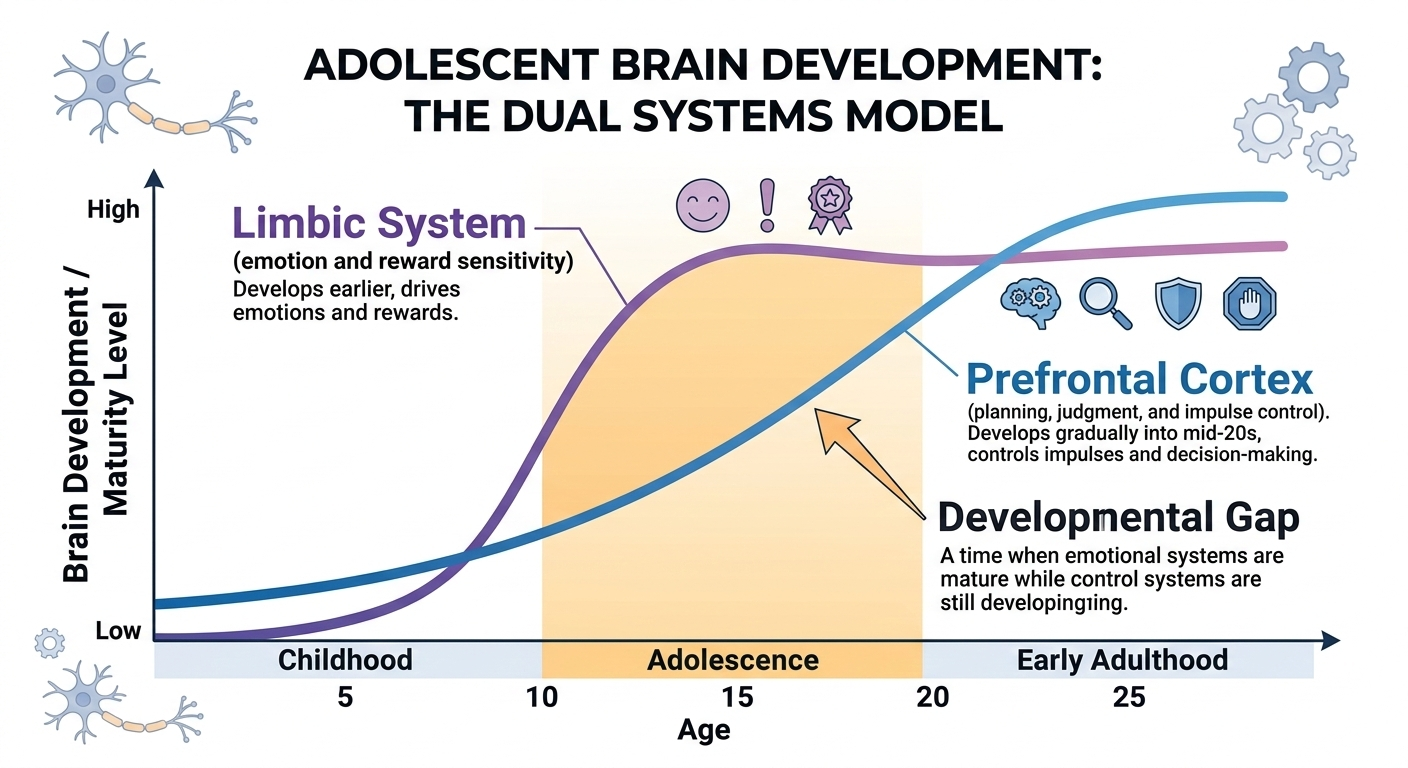
The prefrontal cortex — the brain's "control tower" — is among the last brain regions to reach mature function, continuing development from infancy into early adulthood. This extended developmental timeline has profound implications for coaching adolescents and young adults.
The Adolescent "Gap" Period
During adolescence, a critical "gap" emerges: the limbic system (emotion and reward centers) matures rapidly, while the prefrontal cortex lags behind. This neurobiological mismatch explains why teenagers can understand the consequences of risky behavior intellectually but cannot consistently apply that knowledge in the moment.
For coaches, this gap is not a pathology to be fixed but a developmental reality to be scaffolded. The coach serves as an external prefrontal cortex during this critical window.
PFC Development Timeline
Infancy: Basic inhibitory responses emerge
Early Childhood (3-5): Working memory and cognitive flexibility develop
School Age (6-12): Sustained attention and planning improve
Adolescence (13-17): The "gap" period — emotional drive outpaces cognitive control
Young Adulthood (18-25+): PFC approaches full maturation
The Three Core Dimensions of Executive Function
Working Memory
The ability to hold information in mind and manipulate it. This is the mental "workspace" that allows us to follow multi-step instructions, perform mental math, and connect past experience to present action.
Inhibitory Control
The capacity to resist impulses, filter distractions, and pause before acting. Without inhibition, the other executive functions cannot engage — it is the gatekeeper of self-regulation.
Cognitive Flexibility
The ability to shift perspectives, adapt to changing demands, and think creatively about problems. This is what allows us to revise plans when circumstances change and to see situations from multiple angles.
The Barkley Model: Inhibition as the Keystone
Dr. Russell Barkley's theory is one of the Institute's main pedagogical frameworks for understanding the mechanism of executive function deficits.
EF as Unified Self-Regulation
In Barkley's framework, executive function is not a suite of independent skills but a single, unified system of self-regulation — defined as any action directed at oneself to change one's own behavior so as to change the future. This is a radical reframing: EF is not about intelligence or knowledge, but about the ability to direct behavior across time toward the future.
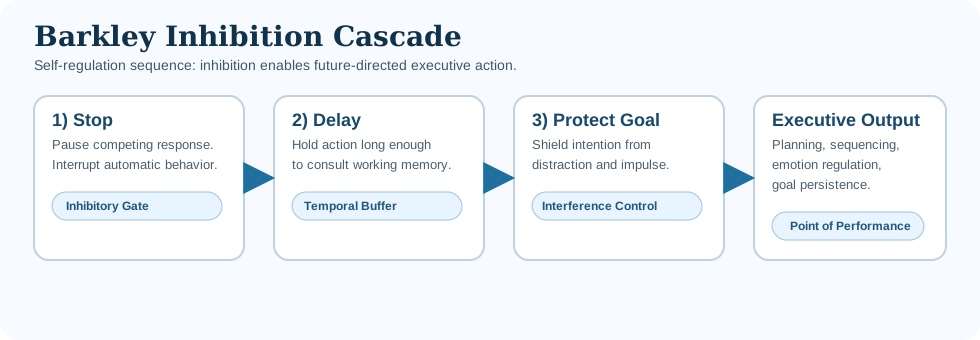
Response Inhibition is the foundational prerequisite for all other executive capacities. Without the ability to "pause" — to inhibit the prepotent response — the brain cannot engage any of the four dependent functions. Think of it as the "Stop, Look, Listen" mechanism: you must first stop the automatic response before you can look at the situation and listen to your internal guidance.
The Four Secondary Functions
When Response Inhibition creates the necessary "pause," these four dependent functions can engage. Each represents a different dimension of internalized, self-directed behavior.
Nonverbal Working Memory
The "Mind's Eye"
The capacity to hold events in mind, re-experience them, and use visual imagery to anticipate future outcomes. This is the brain's "mental video player" — it allows us to replay past events and preview future scenarios.
The "Time Blind" Concept
In Barkley's teaching language, many clients with EF deficits can seem functionally "time blind" because future consequences are harder to hold in mind with enough salience to guide behavior. The future can feel abstract rather than immediate. That framing helps explain chronic lateness, missed deadlines, and weak long-range planning without reducing them to moral failure.
Verbal Working Memory
The "Mind's Voice"
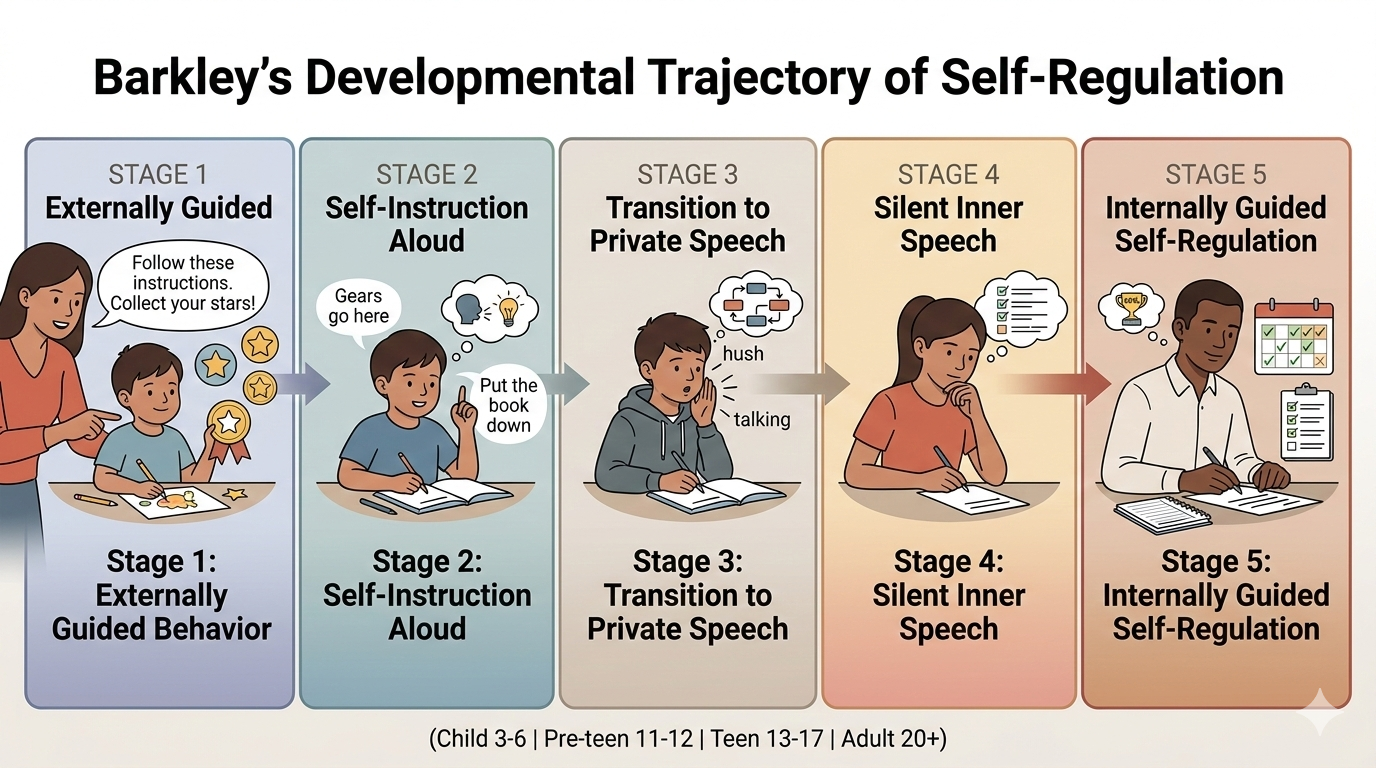
Internalized speech — the running inner monologue that guides behavior. This is how we talk ourselves through problems, give ourselves instructions, and rehearse plans. It evolves from the external speech of early childhood ("I need to put my shoes on first, then my coat") into the silent self-talk of adulthood.
When this function is impaired, clients struggle to use self-instruction to guide behavior, follow multi-step directions, and internalize rules without constant external reminders.
Self-Regulation of Affect/Motivation
The "Mind's Heart"
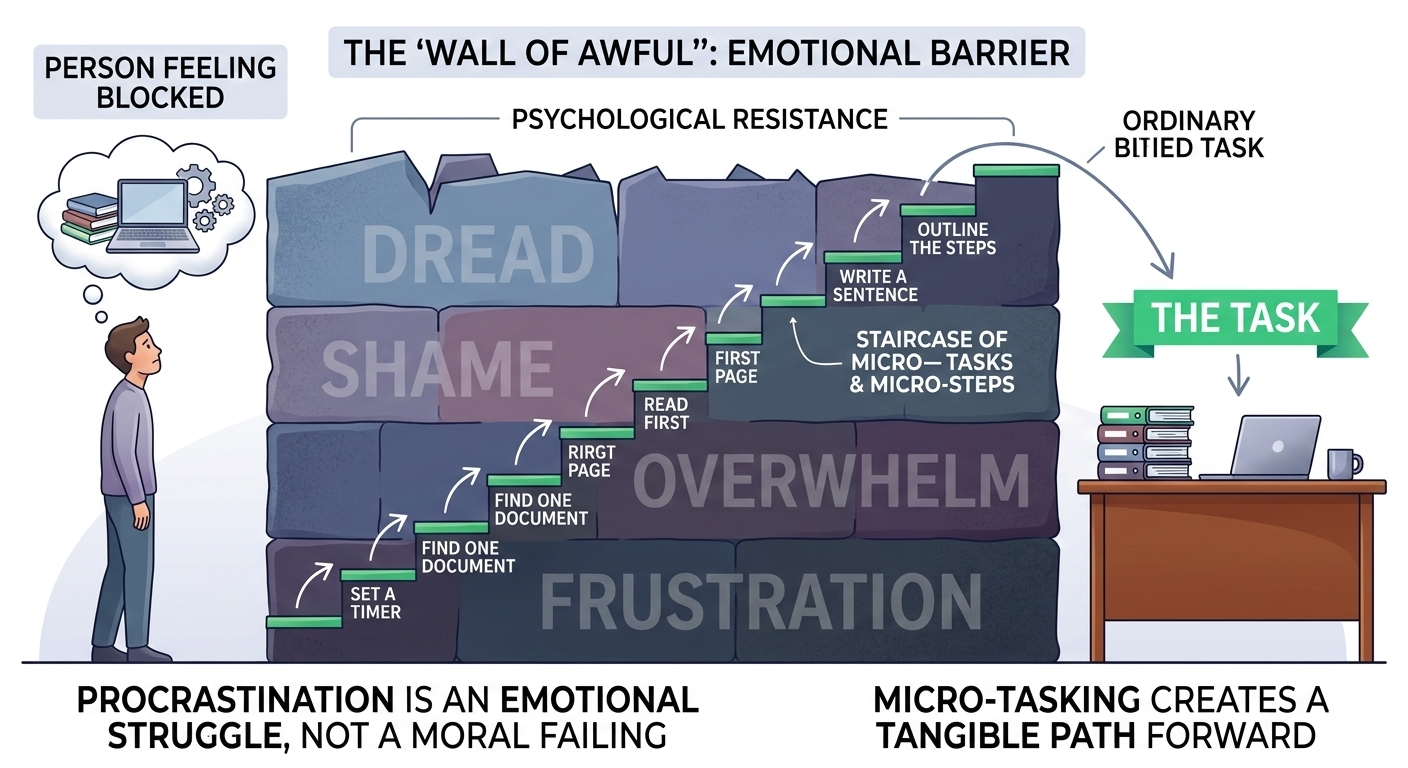
The capacity to moderate emotional states in order to sustain goal-directed action. This function recognizes a critical truth: emotion is not separate from cognition — it drives planning, persistence, and problem-solving.
Clients with impairment in this area display emotional reactivity, low frustration tolerance, and difficulty generating the internal motivation needed to initiate or persist with uninteresting tasks. They are driven by the emotional urgency of the moment rather than the logical importance of future goals.
Reconstitution
The "Mind's Playground"
The capacity for analysis and synthesis — breaking down observed behaviors and sequences into their component parts, then recombining them into entirely novel responses. This is the seat of creativity and flexible problem-solving.
When this function is impaired, clients tend toward rigid, repetitive approaches to problems. They struggle to generate alternative strategies, adapt plans to new information, or combine ideas from different domains into innovative solutions.
The Extended Phenotype
One of Barkley's most useful concepts for coaching practice is the Extended Phenotype — the idea that executive regulation is supported not only by the person but also by the environment they build around themselves. Just as a beaver's dam is part of its phenotype, a person's use of external tools — timers, planners, checklists, visual schedules, phone alarms — can be understood as part of their broader executive support system.
Coaching Implication
This concept is revolutionary for reducing shame. Prosthetic tools are not "crutches" or signs of weakness — they are essential, evidence-informed supports that extend the brain's limited executive capacity into the environment. A person with EF deficits who uses a planner is no different from a person with poor vision who wears glasses. The coach's role is to help design and implement these environmental extensions.
From Deficit Model to Cognitive Accessibility
Modern executive functioning support is increasingly shaped by neurodiversity principles and Universal Design for Learning (UDL), not just by clinical deficit models.
Why This Matters
The emerging open-access ecosystem reframes executive dysfunction as a mismatch between cognitive demands and available supports. That shift changes the coach's job: not merely to explain impairment, but to help clients design environments, routines, and tools that make performance possible across school, home, and work.
Neurodiversity
Differences in executive functioning are not automatically evidence of laziness, character weakness, or poor values. Coaching starts from neurological reality and works toward effective support.
UDL Framing
Good environments reduce unnecessary executive load for everyone. Visual schedules, chunked instructions, reminders, and clear routines are not "special treatment" when they improve access.
Open Support Systems
Publicly available tools, institutional coaching models, and digital prosthetics now make EF support more accessible outside expensive private systems. Coaches should know this landscape.
The Brown Model: Six Clusters of Cognitive Management
Dr. Thomas Brown's model provides a more granular vocabulary for describing the daily manifestations of executive function deficits.
Brown conceptualizes executive functions as integrated clusters that operate like a symphony orchestra — each section must work in concert with the others. When one cluster underperforms, the entire system is affected. Unlike Barkley's hierarchical model, Brown's clusters are interconnected rather than dependent on a single keystone function.
Activation
Organizing, prioritizing, and initiating work. Clients with activation deficits can plan a project in their heads but cannot get started. The task feels overwhelming before a single step is taken.
Focus
Sustaining, shifting, and dividing attention as needed. This cluster explains both distractibility (too little focus) and hyperfocus (too much focus on the wrong thing), which are two sides of the same coin.
Effort
Regulating alertness, sustaining effort, and managing processing speed. Brown identifies this cluster as the most misread by teachers and employers, who interpret inconsistent energy as laziness rather than a neurochemical regulation problem. See the full “dimmer switch” explanation below.
Emotion
Managing frustration, modulating emotional responses, and separating feelings from decision-making. Emotional dysregulation is not a separate comorbidity — it is an intrinsic feature of EF impairment.
Memory
Utilizing working memory and accessing recall. This is not about storage capacity but about retrieval — the information is "in there" but cannot be accessed on demand, leading to the frustrating experience of "I know it, but I can't think of it right now."
Action
Monitoring and self-regulating behavior. This cluster governs the ability to observe one's own actions in real time, adjust course, and maintain appropriate pacing — the "internal supervisor" that watches over performance.
Situational Variability
Brown's most important contribution to coaching is the concept of "Situational Variability" — the observation that EF difficulties can vary sharply by context, interest, reward, and task demand. A client can focus intensely on a video game yet struggle to sustain attention on a textbook. Brown uses this pattern to challenge purely character-based explanations.
This insight is essential for reducing the shame and self-blame that clients carry. It answers the question that haunts every person with EF deficits: "If I can do it sometimes, why can't I do it all the time?"
The "Dimmer Switch" Metaphor
Brown describes alertness and effort regulation using the metaphor of a dimmer switch rather than an on/off toggle. Neurotypical individuals can adjust their alertness levels to match task demands — turning up the "brightness" for a boring meeting and dimming it for relaxation.
For individuals with EF impairments, the dimmer switch is unreliable: it gets stuck at the wrong setting, shifts randomly, or requires extreme external stimulation to move at all. This explains the chronic underarousal that leads to procrastination and the sudden hyperfocus that makes time disappear.
When To Use Barkley vs Brown In Sessions
Use Barkley when explaining the mechanism to parents, schools, or referral partners ("this is an inhibition and self-regulation system problem"). Use Brown when validating the lived client experience ("your activation, effort, or memory clusters are inconsistent by context, not by character").
The Evolutionary Perspective: Public to Private
Barkley's evolutionary model reveals how executive functions develop through the internalization of once-public behaviors — and why coaching works by temporarily re-externalizing them.
The development of executive function follows a consistent pattern: behaviors that begin as public, external actions gradually become private, internalized processes. Understanding this trajectory is the key to understanding both the nature of EF deficits and the logic of coaching interventions.
Children Talking Out Loud → Internalized Self-Talk
Young children narrate their actions aloud: "Now I'm going to put the red block on top of the blue block." Over time, this external speech becomes internalized as the "inner voice" that guides adult behavior. When this internalization is delayed or incomplete, the individual lacks the internal verbal compass that neurotypical adults take for granted.
External Rewards → Internalized Motivation
Children initially require external incentives (stickers, praise, tokens) to sustain effortful behavior. As executive functions mature, individuals develop the capacity to generate internal motivation — to persist with a boring task because they can envision the future reward. When this internalization fails, the individual remains dependent on immediate, external reinforcement.
External Rules → Internalized Self-Governance
Behavioral rules move from external authority ("Your teacher says no running in the hallways") to internalized principles ("I should walk because running could hurt someone"). Individuals with EF deficits may understand rules intellectually but struggle to apply them automatically in the moment of performance.
The Coaching Connection
This evolutionary perspective provides the theoretical justification for EF coaching itself. Coaching is the deliberate re-externalization of executive functions. When a coach provides verbal prompts, visual schedules, external accountability, and environmental modifications, they are temporarily restoring the "public" scaffolding that the client's brain has not yet fully internalized. The goal is not permanent dependence but a gradual "fading" of supports as the client's own neural circuits strengthen.
Unit Summary
Module 1 is organized into three units, each building on the previous unit to create a clear theoretical base.
This unit introduces Barkley's model of executive function as unified self-regulation, with Response Inhibition as the foundational keystone. Trainees study the "Stop, Look, Listen" mechanism, the four secondary functions (Nonverbal Working Memory, Verbal Working Memory, Emotional Self-Regulation, and Reconstitution), and the concept of the Extended Phenotype.
- EF as self-directed action aimed at changing the future
- The hierarchical relationship between inhibition and the dependent functions
- Time blindness and temporal myopia
- The Extended Phenotype: prosthetic tools as essential supports
- The evolutionary trajectory from public to private behavior
This unit explores Brown's Six Cluster model as a complementary lens for understanding the daily manifestations of EF deficits. Trainees learn to apply the concepts of Situational Variability and the "dimmer switch" metaphor to reduce client shame and build psychoeducational narratives.
- The six clusters: Activation, Focus, Effort, Emotion, Memory, Action
- The symphony orchestra metaphor for integrated function
- Situational Variability: chemically modulated, not willful
- The "dimmer switch" metaphor for alertness regulation
- Integrating Barkley and Brown into a unified coaching narrative
This unit provides the neuroanatomical context for the theoretical models, grounding abstract concepts in physical brain structures and developmental timelines.
- The Prefrontal Cortex (PFC): the "control tower" and its developmental trajectory
- The Striatum: reward processing and motivation circuits
- The Cerebellum: timing, coordination, and procedural learning
- "Cool" EF vs. "Hot" EF: the distinction between logic-based and emotion-based executive processes
- The PFC maturation timeline from infancy into early adulthood
Module 1 Assignment
The "Temporal Horizon" Analysis
Objective
Internalize the concept of "Time Blindness" and its real-world impact on planning, relationships, and life outcomes.
Assignment Requirements
Length: 1,500 words
Prompt
Write a detailed analysis contrasting the "temporal horizon" of a neurotypical 25-year-old with that of a 25-year-old with significant executive function deficits. Your analysis must address the following domains:
- Financial Planning: How does "temporal myopia" affect budgeting, saving, debt management, and long-term financial decision-making?
- Career Development: How does an impaired temporal horizon impact goal-setting, professional advancement, project completion, and workplace performance?
- Relationship Maintenance: How does time blindness affect the ability to sustain friendships, romantic partnerships, and family obligations over time?
- Must cite at least 2 specific Barkley functions accurately (for example, inhibition + nonverbal working memory).
- Must analyze all 3 required domains: financial planning, career development, and relationship maintenance.
- Must include 1 concrete intervention per domain with explicit implementation steps.
- Must show extended phenotype thinking (external tools/environmental design, not willpower-only advice).
Coaching Interventions
Propose three specific coaching interventions grounded in the Barkley model that could help close the temporal horizon gap. For each intervention, explain:
- Which of Barkley's four secondary functions the intervention targets
- How the intervention serves as an "Extended Phenotype" tool
- A concrete implementation plan the coach would use in session
Evaluation Criteria
Submissions will be evaluated on: (1) accuracy in applying Barkley's theoretical constructs, (2) depth of analysis across all three life domains, (3) specificity and practicality of proposed coaching interventions, and (4) evidence of original thinking beyond mere restatement of course material.
Go Deeper with Free Foundational Sources
Previous Module
No previous moduleReady to Begin the Certification?
Module 1 is just the beginning. Enroll now and build the theoretical foundation for a career in Executive Functioning Coaching.