Mechanism
Barkley explains why the gap shows up at the point of performance
EFI uses Barkley to explain why clients can know what to do and still struggle to initiate, sustain, or regulate action in real time.
Institute Profile
EFI is built as a public-facing institute file: model language, teaching logic, and operating boundaries are visible before any reviewed service is offered.
This page explains what EFI is, what intellectual traditions it draws from, and how the institute distinguishes open educational material from paid review and credential work.
EFI is intentionally document-heavy in public. The institute file is meant to show how the program thinks, what it teaches, and where the reviewed boundary begins.
EFI sits at the intersection of education, coaching practice, and applied executive-function support, but it organizes those domains into a named teaching system rather than a loose collection of advice.
As awareness of neurodiverse profiles — specifically ADHD and Autism Spectrum Disorder — expands beyond diagnosis into mainstream educational and workplace contexts, the demand for specialized executive-function support has grown sharply. Yet the field remains largely unregulated, with a significant gap between the quality of available research and the rigor of practitioner training.
Our internal certification pathway is built on the synthesis of multiple theoretical models into a single, actionable coaching framework — one designed to be research-literate, ethically bounded, and practically useful.
Core Philosophy
“Executive function deficits are rarely deficits of knowing; they are deficits of doing. The role of the coach is not merely to teach a client how to use a planner, but to act as an external scaffold while training the client's own neural circuits to eventually assume command.”
What Makes Us Different
Unlike generic life coaching programs, our curriculum rejects the notion of EF issues as "behavioral choices" or "character flaws," instead grounding all instruction in the neuroanatomy of the prefrontal cortex and the developmental trajectory of self-regulation.
EFI is currently founder-led with transparent ownership and public accountability.
Founder and curriculum lead for The Executive Functioning Institute. EFI's model combines open educational access with paid competency review, credential verification, and alumni pathway infrastructure.
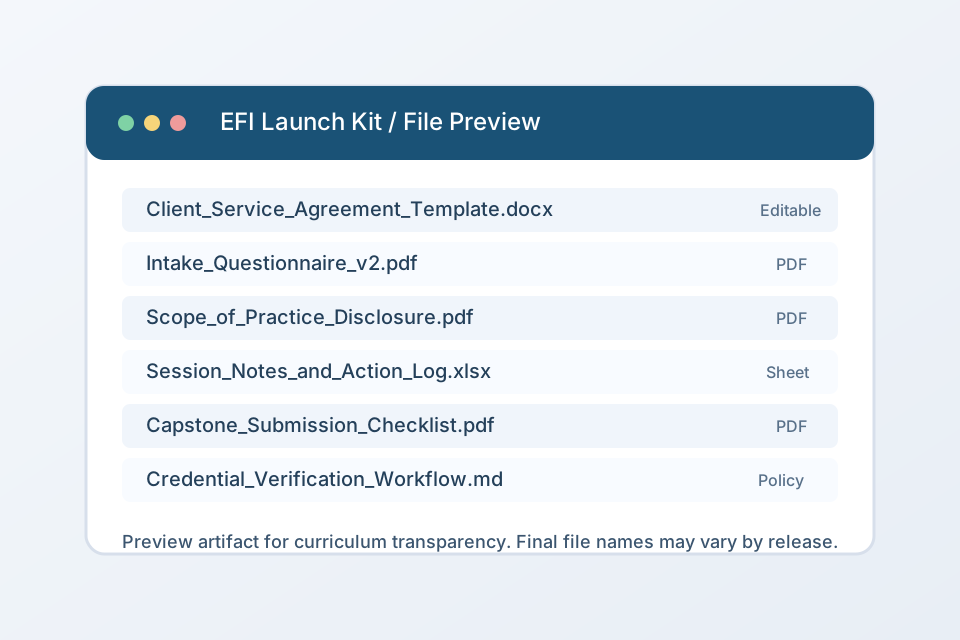
Public Accountability Surface
EFI is strongest when leadership is legible in the work itself: published standards, named frameworks, open curriculum pages, and a clear boundary around reviewed evaluator labor.
The institute does not rely on one framework to do every job. The visual stack below shows how the program moves from causal explanation to intake language to practical coaching execution.
Mechanism
EFI uses Barkley to explain why clients can know what to do and still struggle to initiate, sustain, or regulate action in real time.
Client language
The six clusters help parents, educators, and practitioners name the pattern they are seeing without collapsing it into a character story.
Execution layer
EFI uses skills maps and backward-planning methods so coaching becomes a sequence of external scaffolds, not generic accountability talk.
Our program combines three major executive function models into one practical coaching framework, and each model is used for a different kind of judgment.
Dr. Thomas Brown's model provides a more granular vocabulary for describing the daily manifestations of EF deficits. He presents these functions as integrated clusters rather than isolated, independent skills.
EFI uses Brown’s cluster model as the primary client-facing vocabulary because it maps directly to the frustrations people describe in intake sessions. Where Barkley explains the mechanism, Brown gives coaches language for the lived experience — including the Situational Variability pattern that Module 1 explores in depth.
Coaches use this cluster to diagnose “I know what to do but can’t start” patterns
Explains both distractibility and hyperfocus as two sides of the same attentional coin
Reframes inconsistent energy as neurochemical, not motivational — key for parent and teacher education
Positions emotional flooding as intrinsic to EF, not a separate comorbidity to refer out
Distinguishes retrieval failures (“I know it but can’t access it”) from storage deficits
The “internal supervisor” — gives coaches language for pacing and self-monitoring goals
Drs. Peg Dawson and Richard Guare offer the most practical, skills-based framework for coaching. They categorize executive function into 12 distinct skills, separated into two domains: "Thinking" (Cognition) and "Doing" (Behavior).
This separation is crucial — a client may possess high-level cognitive EF (able to plan a complex project) but suffer from severe behavioral EF deficits (unable to initiate the first step).
Sarah Ward and Kristen Jacobsen's methodology is widely used for visual-spatial approaches to time and task management.
Visualize the final outcome first: "What will it look like when I am finished?" This utilizes nonverbal working memory (visual imagery) identified by Barkley.
Once the end state is visualized, identify the specific action steps required. Map the work backward from the finished product to the present moment.
Finally, determine what materials are needed to start. This reverses the typical impulsive approach of grabbing materials without a plan.
The "open source" nature of this curriculum implies a commitment to lifelong learning — constantly seeking out new research, new tools, and new perspectives.
Pioneer in ADHD and executive function research. His model of executive functions as self-regulation and the concept of the "Extended Phenotype" form the theoretical backbone of the curriculum.
Developer of the Six Cluster model of executive function impairments in ADHD. His work on "situational variability" is essential for explaining why EF deficits are context-dependent.
Authors of the executive-skills framework and the Executive Skills Questionnaire (ESQ-R). EFI uses their public ESQ-R intake model as one coaching-oriented assessment layer alongside its own interactive tools.
Developers of the 360 Thinking model and the "Get Ready, Do, Done" methodology. Their visual-spatial strategies for backward planning are central to Module 4.
Provides the foundational "Air Traffic Control" metaphor for executive function and publishes the activity guides used as core open-source reading material in the curriculum.
Now that you understand the theoretical foundations, explore how each model translates into coaching sessions, assessment protocols, and intervention design across six modules.