Planning First
Begin each session with an execution plan: outcome target, first step, friction points, and start trigger.
- Define "done" before content work
- Estimate duration and correction factor
- Select fallback if task stalls
For educators moving from content delivery toward process coaching, metacognitive transfer, and independent execution.
EF coaching does not replace subject expertise; it changes session architecture so the learner can self-initiate, self-monitor, and generalize across contexts.
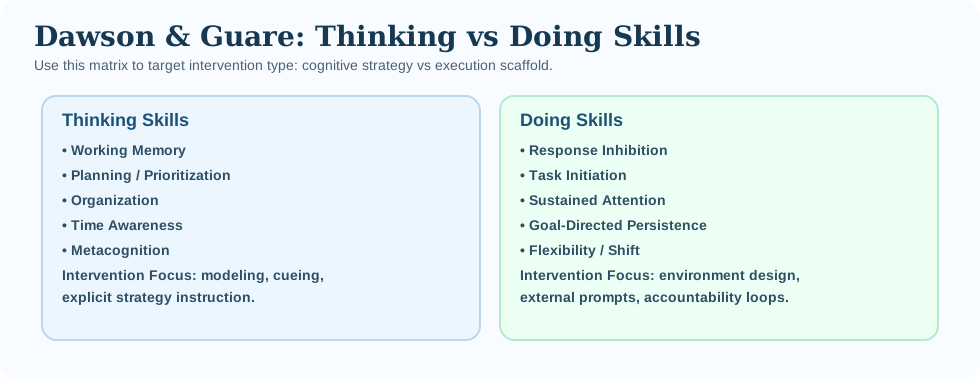
Begin each session with an execution plan: outcome target, first step, friction points, and start trigger.
After work blocks, capture what worked, where breakdown happened, and what to carry into the next attempt.
Do not close on one successful task. Add a transfer rep in a new context so the process becomes reusable.
Every tutoring-style content segment should be wrapped by a coaching loop: pre-plan, execution monitoring, and post-task adaptation.
Use these as drills to practice the process shift under realistic pressure.
Context: Student asks for sentence-level edits 45 minutes before deadline.
Context: Learner delays work daily despite knowing the steps.
Evidence note: this structure aligns with ICF competency language for awareness and growth facilitation, plus Barkley/Dawson emphasis on performance supports at point-of-performance.
Use these scripts when a learner asks for direct answers. The goal is to train process ownership, not dependency.
Teacher: \"You forgot to carry the one. Fix this line, then multiply this part.\"
Result: immediate task accuracy, low transfer, high dependence.
Coach: \"Pause. What strategy worked on the last problem?\"
Coach: \"If you had to find the next step, where would you look first?\"
Coach: \"Great. Open your notes and identify the step that matches where you are now.\"
Coach: \"You solved it. What clue told you to check your notes instead of guessing?\"
Why this works: it encodes the process cue, not just answer recovery.
If a source is paywalled or restricted, see Resource access notes for legitimate acquisition paths.